Bengos practice passages are not available in print. Please use the site to practice.
Typing practice on rule statements for the essay issues past bar exams have tested most often. Drill them until they come without hesitation, so more of your exam time is left for the analysis.
7-day free trial. No credit card required.
These are real Quick Rules from the library, the short form you might write under time pressure. No account needed. Keywords are bold, and tests and standards are underlined.
Try it here, then study on your computer. Bengos is built for a physical keyboard, the way the essay portion is typed on exam day.
Every rule in the library is written to be typed like that one.
Bengos does one thing: it drills rule statements for the essay issues past exams have tested most often. Full treatment of the law is best left to bar prep programs: this is not a complete rule set, and it does not replace a full outline. Use it alongside a course, or on its own when full prep is not an option: repeat takers, working professionals, parents, and attorneys sitting for only the written portion of the exam.
Essay answers tend to lose points in a few predictable ways, and most of them respond to practice.
You have read the outline more than once, but on a timed essay the sentence still does not form. Typing a rule until it is automatic takes the hesitation out of the first sentence.
The subjects you covered in your first weeks slip while you are busy with the later ones, and rereading all of them every week is not realistic.
Slow rule statements use minutes the analysis needs. A rule you can write without stopping to reconstruct it leaves more of the question for the analysis.
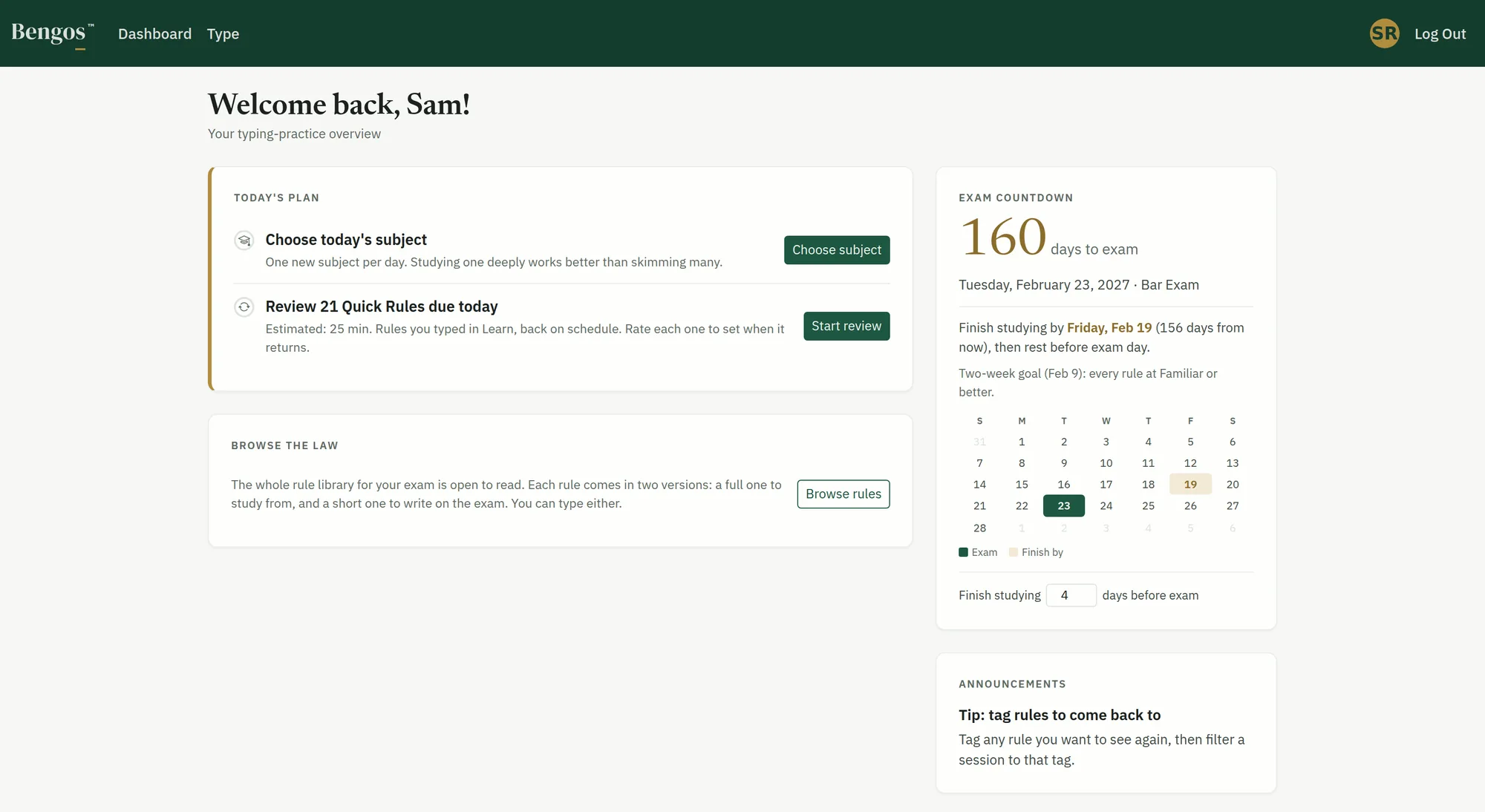
One new subject a day, reviews scheduled for you, and a dashboard that shows today's work.
Memory tends to fade fastest right after you learn something. Each time you come back to it, it fades more slowly, so the next review can wait longer than the last one. Spaced repetition is the practice of scheduling reviews on that pattern: a few well-timed passes over a rule instead of rereading everything.
The timing comes from a spaced-repetition algorithm. After each review you say how well you knew the material, and that sets the next wait. Rules you find hard keep coming back. Easy ones wait longer each time. Two people studying the same library end up on different schedules.
The items are rule statements. After each pass you give the rating yourself: Not Comfortable, Familiar, or Know It Well. That rating is the only input. Rate a rule well and the gap before it returns grows; rate it Not Comfortable and it comes back soon. Your typing speed and accuracy are recorded for you, but they never move the schedule.
It saves you time. Each day you get a short list, already narrowed to the rules you are least sure of, instead of rereading the whole library.
The rule statement by itself earns little. State it correctly and fast, and you have more time for the most important part of the essay: applying the law to the facts.
Many candidates never once write a rule statement out before the exam, and the common instinct, writing everything the outline said, uses up the time the analysis needs. Bengos gives every rule two editions.
The Quick Rule is the core statement worth writing under time pressure, aimed at minimum competence. State it, then add only what the facts make relevant.
Learn mode serves the Study Rule so you understand the law. Review mode drills the Quick Rule so your hands automate the exam-day form.
Every rule also carries its testing history, drawn from released exams and published answers.
Zero to three flames show how often the issue has appeared on released exams, so you can set priorities when time is short.
Each pill names the administration and question number, so you can pull the released question and its published answers.
Where a rule is often misapplied, the passage carries a note on the mistake.
That is what each rule carries. The work itself is three steps.
Its essay rule-statement library is ready on day one. Nothing to build and nothing to import.
Choose your subjects. In Learn mode you type the full Study Rule with its structure visible: keywords bold, tests underlined.
Rate your confidence after each passage. That rating sets when the rule comes back to you.
All of it runs from one dashboard.
New material and spaced review are separate decks. A review session gives you only what is due, and starting a new subject stays your decision.
Your ratings are the only input to the review schedule. Typing speed and accuracy never are.
Today's work, the exam countdown, and your coverage and confidence by subject on one page.
Keywords bold, tests and standards underlined. You type the plain text.
Mark key phrases, keep private notes, and filter a session to your own tags.
Speed and accuracy per session, and the words you mistype most.
Practice toward 50 words per minute. Whichever exam you take, that is enough to write an answer of workable length in the time each essay allows, with margin for exam-day conditions. The target is an estimate: how we arrived at it.
Learn and Review are the two modes, and at first you do both in about ninety minutes a day. It does not have to be one sitting, and we will remind you to take breaks. Once Learn mode has no new subjects left, all that remains is clearing the Review deck for that day, which can be as little as half an hour. Spaced repetition is what makes that efficient: the schedule keeps each day's list to what is actually due.
Those breaks are a good time for the rest of your plan: your bar prep course, multiple-choice practice, and full essays and performance tests. Bengos is a supplement to a study strategy, not a replacement for one.
Start as early as you can. Two months out is the minimum, not the date to wait for. Typing speed and recall both build gradually, so a longer window means shorter days rather than more work, and no rush in the final weeks. One flat price covers access through your exam week whenever you buy it, so an earlier start adds study days and costs nothing extra. Work you cover steadily is work you are not compressing into the last weeks before the exam.
Start with a 7-day free trial. No card needed.
Access through your exam week. Not a subscription.
Seven days free. Rule statements for the most-tested essay issues on your exam, ready from your first session.
Start Free TrialLeave your email and we will keep you informed about what Bengos offers.